


For the last few years, most organisations have been exploring how AI can help people work faster, generate content, analyse data and improve productivity. But a new question is now emerging:
Can AI do things on our behalf?
As businesses move from AI assistants to AI agents, the challenge is no longer simply about choosing the right AI model. Increasingly, success depends on the quality, structure and accessibility of the information those agents rely on.
In this month’s Horizon Intelligence Brief, we explore:
Much of the AI discussion to date has focused on assistants.
Tools that help us write content, analyse data, answer questions and improve productivity have delivered significant value. But the market is now beginning to move towards something different: AI systems capable of making decisions, taking actions and coordinating work across multiple tools and workflows.
The question is no longer “Can AI help me do this?”
It’s increasingly becoming:
“Can AI do this on my behalf?”
This shift represents a major change in how organisations think about AI. It moves AI from a supporting role into an operational one, where systems are expected to participate directly in business processes.
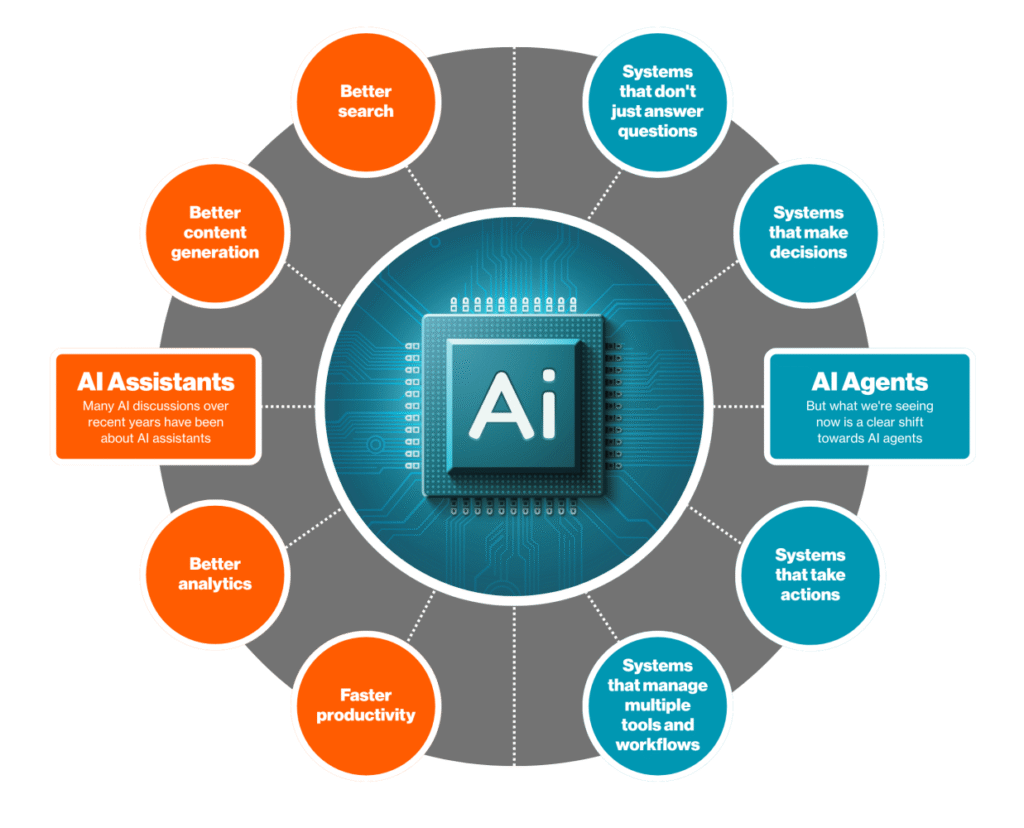
The conversation is shifting from what AI knows to what AI can do.
One of the most important lessons emerging from agent development is that the biggest barriers are rarely the AI models themselves. The difference between mediocre and impressive outcomes often comes down to the quality of the environment in which agents operate.
We’ve found that agents require three critical foundations:
Reliable, accurate and structured information.
An understanding of what information means, where it came from and how trustworthy it is.
The ability to find relevant information quickly and consistently when it is needed.
Many organisations are focused on exposing APIs or adding AI interfaces to existing systems. But providing access to information is not the same as making information understandable. For agents, context is everything.
The organisations achieving the greatest value from AI aren’t necessarily deploying the most agents – they’re investing in information that agents can actually understand.
Before an agent can make a recommendation, personalise an experience or automate a decision, it must first understand who the customer is.
Yet many organisations still struggle with:
An agent can only make decisions using the customer information it can access.
The same challenge exists for product data. Agents need to understand products before they can recommend, compare, discover or explain them.
Common issues include:
The quality of an agent’s output will always be limited by the quality of the information it understands.
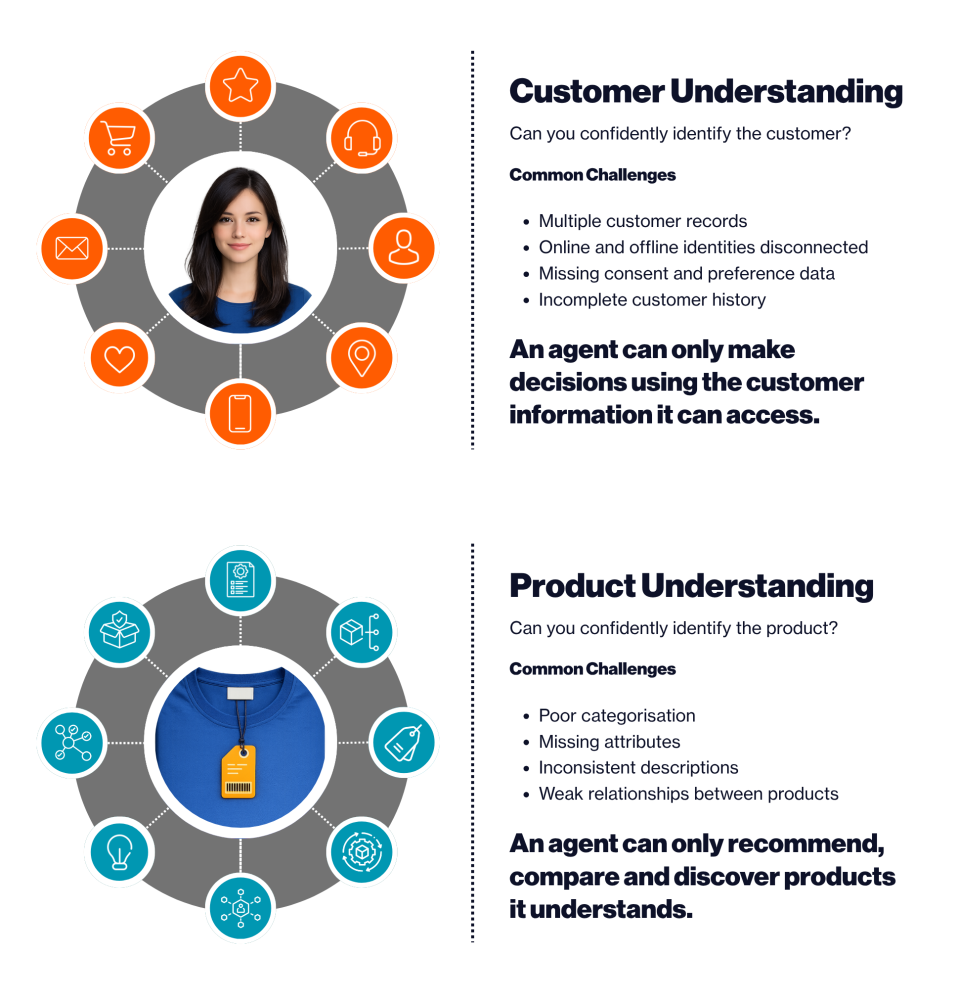
AI doesn’t just need data. It needs a trusted understanding of customers, products and their relationships.
Historically, customer intelligence platforms were designed to help people understand customers. Data flowed through analysts, marketers and business users before action was taken. Increasingly, a new consumer of intelligence is emerging:
Unlike humans, agents are highly dependent on structure, metadata, relationships and semantic understanding. Humans can often work around ambiguity – agents cannot.
This is why Horizon’s strategic direction increasingly focuses on semantic understanding, discoverability and the creation of trusted intelligence that can be consumed by both people and machines.
For years, many organisations treated activities such as documentation, taxonomy management, data governance and knowledge management as background tasks.
AI has changed that.
The organisations generating the strongest outcomes from AI are often the ones that have invested heavily in:
Interestingly, perfect data is not always required. Agents are surprisingly capable when uncertainty is visible and well documented. The real problem arises when information gaps are hidden.
Organisations should focus on exposing limitations, documenting confidence levels and making information easily accessible.
A common response to the rise of agentic AI has been to make systems “agent-ready” by exposing APIs through MCP (Model Context Protocol). While this is an important step, it is only the beginning.
An MCP endpoint is not the same as a great agent experience.
Just as organisations spent years learning how to design user experiences for people, we are now learning how to design experiences for agents.
This requires deliberate thinking around:
The future will belong to organisations that make it easy for agents to understand how their systems work.
At Horizon, we believe the future will be shaped by AI agents, natural language interfaces and third-party AI systems interacting directly with business intelligence.
That means the challenge is no longer simply having data. The challenge is ensuring that data can be understood, discovered and trusted by both humans and machines.
This is the thinking behind initiatives such as:
The intelligence layer is becoming increasingly important as organisations adopt AI at scale.
While much of the industry discussion centres on AI models and new agent capabilities, one area remains critically important:
It may not sound exciting, but product information is rapidly becoming the fuel that powers agent-driven commerce.
Future AI systems will increasingly understand:
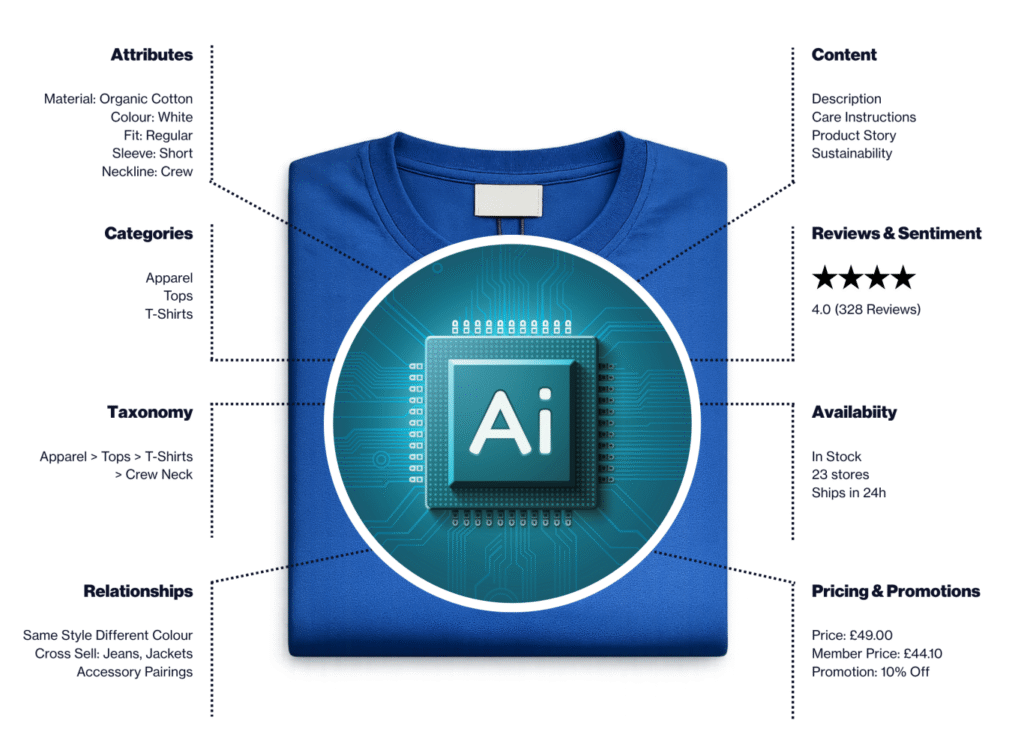
Great AI starts with great product understanding.
The retailers that succeed won’t simply be those with agent access. They will be the retailers whose products are easiest for agents to discover, understand and trust.
Rich attributes, strong taxonomy, detailed content, product relationships, availability, pricing and contextual information will all become competitive advantages in an AI-driven market.
The AI conversation often focuses on large language models. But the real competitive advantage is increasingly moving elsewhere.
AI capability is becoming widely available. Access to powerful models is becoming easier. Differentiation based solely on the model itself will become harder to sustain.
The organisations that win will be those that structure knowledge effectively.
Those that create information which is:
Because agents can only act on what they can discover, understand and trust.
The future belongs to organisations that are designed to be understood – not just by people, but increasingly by the AI systems that will help drive decisions, experiences and growth.
At Horizon, we believe the shift from assistants to agents is not primarily an AI problem.
It’s a data, context and intelligence problem.
As organisations accelerate their adoption of AI, the focus must move beyond models and towards the quality of the information environment those models operate within.
Because in the age of agentic AI, intelligence is becoming the most valuable asset of all.
Whether you’re exploring AI readiness, customer intelligence, data strategy or the future of agent-driven experiences, we’d love to continue the conversation.
Visit our Contact Us page to speak with the Horizon team.